
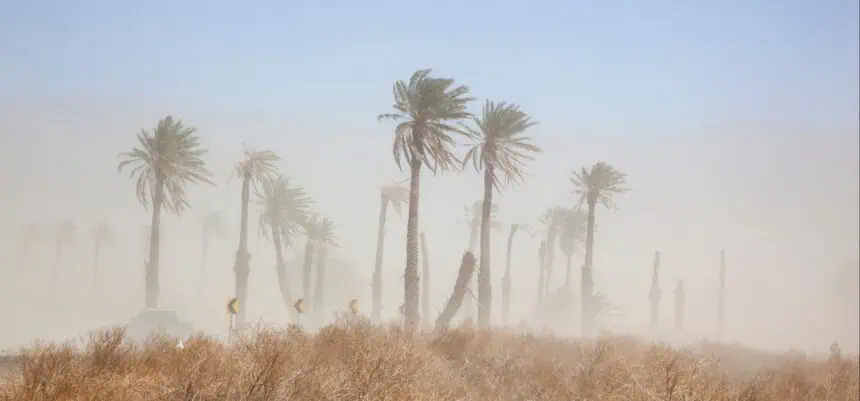

Dust storms are increasingly threatening parts of California, and scientists warn they’re only going to become more common due to the intensifying effects of climate change and human land use. In November 2024, a powerful dust event in the Central Valley disrupted power and shut down traffic, offering a glimpse into what may be a more frequent hazard in the years ahead.
Dust storms surge in Central and Southeastern California
When strong winds whip across dry, exposed land, they kick up fine soil particles, reducing visibility and sometimes halting entire highways. This is exactly what happened last November, when gusts ripped through the Central Valley, forcing drivers to a standstill and cutting off electricity across swaths of the region.
According to Amato Evan, an atmospheric scientist at UC San Diego, dust storms can range from localized plumes to events spanning entire cities. Evan leads UC Dust, a collaborative initiative uniting researchers from across the University of California system to devise solutions to dust-related threats.
Their latest report reveals that dust storms not only jeopardize transportation and infrastructure, but also pose a significant risk to public health, especially in areas where human activity has transformed the landscape.
Agriculture and water policy feeding the problem
Dry regions in southeastern California, such as the Imperial and Coachella valleys, already experience dust storms regularly—especially in spring, summer, and fall. However, human intervention has made other regions more vulnerable.
One stark example is Owens Lake. Once filled with water, the lake was largely drained in the 20th century to supply Los Angeles, leaving behind a dust-prone basin that now frequently emits fine particles into the atmosphere.
In the San Joaquin Valley, intensive agricultural development has stripped the land of protective vegetation, producing vast areas of fallowed farmland. According to Adeyemi Adebiyi, an atmospheric scientist at UC Merced, this bare, dried-up soil is particularly susceptible to wind erosion.
The Sustainable Groundwater Management Act of 2014 has also contributed. Aimed at conserving aquifers, the policy has led to reduced irrigation and the retirement of cropland, inadvertently increasing the area of dust-generating surfaces.
Climate change adds another layer of risk
As temperatures rise, arid zones are growing even drier. “We get these less stable, more degraded soils that are easier for the wind to lift,” said Evan. That drying trend not only weakens the natural vegetation that anchors the soil, but it may also extend dust storm zones into areas like the Sacramento Valley, where such events were once rare.
Health impacts and the threat of Valley fever
Beyond the inconvenience and danger posed to drivers, dust storms can have serious health consequences. Fine particles inhaled during storms are linked to asthma, respiratory illnesses, and negative pregnancy outcomes, according to Alexandra Heaney, a climate and health epidemiologist at UC San Diego.
A specific concern in California is valley fever, a respiratory illness caused by a soil fungus that can be carried by dust. Although the disease has traditionally been confined to the Southwest, including California, changing weather conditions could allow it to spread further.
Heaney is leading a new study that will explore how maternal exposure to dust in California might correlate with adverse birth outcomes.
Looking ahead: Strategies under study
Replanting native grasses and vegetation may help stabilize dust-prone soils, but these projects are both costly and resource-intensive, requiring water that is already in short supply. Meanwhile, targeted dust forecasts for high-risk areas like the Imperial and Coachella valleys are under development, aiming to minimize health exposure during high-dust conditions.