

Visibility possible in 8 northern states on Tuesday night
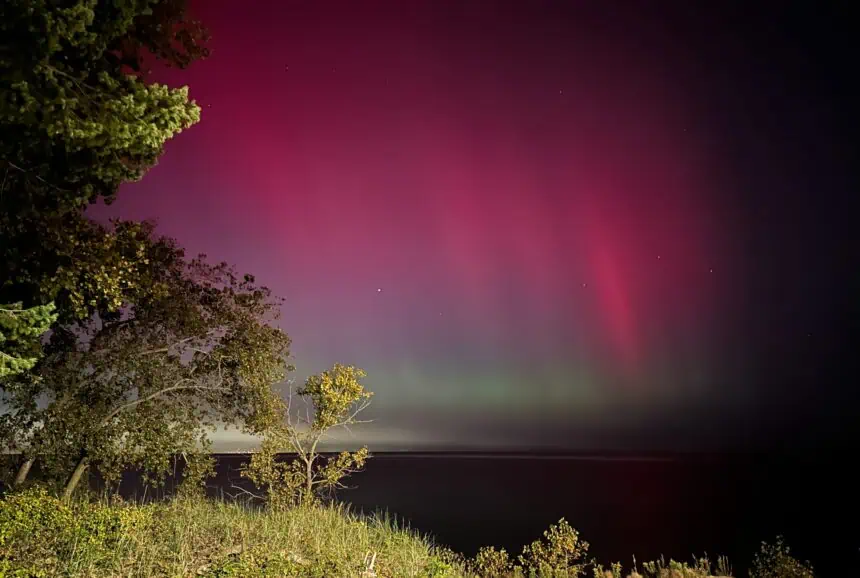
Tuesday night, some parts of the Northern United States could be treated to a dazzling display of the aurora borealis, thanks to geomagnetic activity influenced by solar conditions. According to the National Oceanic and Atmospheric Administration (NOAA), auroral activity is expected to increase slightly, with a Kp index of 3—enough to potentially make the northern lights visible beyond the polar regions.
What is causing the auroral activity
Forecasters at NOAA note that although no minor or stronger geomagnetic storms are forecast through Thursday, active auroral periods are likely due to the presence of a cooler, less dense coronal hole on the sun’s surface. This solar phenomenon can subtly amplify geomagnetic activity, enhancing the visibility of auroras. However, conditions are expected to calm as the week progresses, with the Kp index dropping to 2 on both Wednesday and Thursday.
States with the best chance to see the northern lights
The northern lights may be visible in a narrow band just south of the Canadian border, especially in the following states:
Northeastern Washington, Northern Idaho, Montana, North Dakota, Northern Minnesota, Northern Wisconsin, and Upper Michigan.
While Canada and Alaska remain the most favorable locations, U.S. skywatchers in these areas have a marginal but real chance to spot the phenomenon under clear skies.
Best time and conditions for viewing
The ideal window for catching a glimpse of the aurora borealis is between 10 p.m. and 2 a.m. local time. NOAA strongly recommends heading to a north-facing high vantage point, as far away from urban light pollution as possible. Clear, dark skies are essential for viewing the subtle green, purple, or red glows of the aurora.
Capturing the moment: photography tips
For the best photos of the northern lights:
Photographers should use a wide-angle lens, with an aperture (F-stop) of 4 or lower, set the focus to infinity, and use a tripod to avoid blur. For smartphone users, NOAA suggests activating night mode and turning off the flash for clearer and brighter results.
Why auroras are more frequent now
Since October 2024, the sun has entered a phase known as “solar maximum,” the most active part of its 11-year cycle. This period is marked by frequent solar flares and coronal mass ejections, which send high-energy particles toward Earth. When these particles collide with oxygen and nitrogen molecules in the atmosphere, the result is the spectacular glow known as the aurora borealis.
This phase is expected to continue into early 2026, offering even more opportunities for rare aurora sightings across the continental United States.