

Geomagnetic activity intensifies northern lights over the U.S.
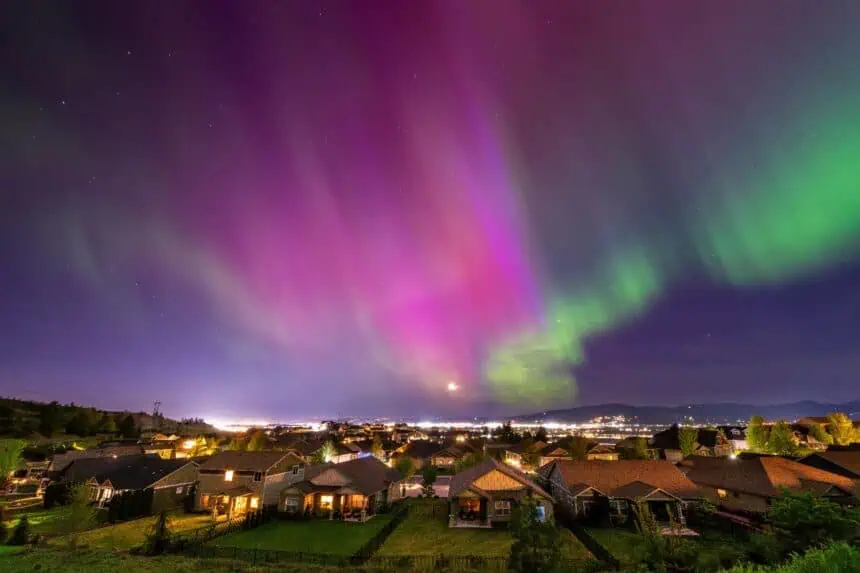
A rare and visually spectacular opportunity is unfolding this Thursday night, as the northern lights — typically confined to polar regions — may grace skies across at least 10 U.S. states. According to the National Oceanic and Atmospheric Administration (NOAA), an elevated geomagnetic storm is currently in effect, allowing the aurora borealis to drift significantly farther south than usual.
Peak viewing conditions expected Thursday night
NOAA is forecasting a Kp index of 4, a moderate but active geomagnetic level on a scale that peaks at 9. Earlier in the day, activity spiked to a Kp index of 6, which classified as a minor geomagnetic storm. These intensified conditions have likely already extended the aurora’s reach into parts of Oregon, Wyoming, Iowa, New York, New Hampshire and Vermont.
While Thursday night offers the best chance for visibility, the activity is projected to subside by Friday and Saturday, dipping back to a Kp index just above 3. That means Thursday evening into early Friday morning — particularly between 10 p.m. and 2 a.m. — is the optimal window to catch a glimpse of the ethereal lights.
Where to look for the aurora tonight
The strongest chances of seeing the northern lights remain in northern Canada and Alaska. However, visibility extends into parts of the Upper Midwest and Northeast United States. The following states may catch a fleeting or faint display:
- Montana, North Dakota, Minnesota, and Upper Michigan have moderate odds.
- Washington, Idaho, South Dakota, Wisconsin, and Maine face lower, but possible visibility.
Residents in rural or elevated areas, especially those facing north and away from city lights, will have the best chance to enjoy the spectacle.
Northern lights and potential disruptions
The geomagnetic activity not only powers the aurora but may also cause minor to moderate radio blackouts. NOAA warns of the possibility of stronger disruptions to high-frequency communications, though significant impacts remain unlikely through Saturday.
How to view and capture the lights
For ideal viewing, experts recommend heading to dark, elevated locations far from artificial lights, with a clear north-facing horizon. Photography enthusiasts should use tripods, wide-angle lenses, and low aperture settings (f/4 or lower). Smartphone users can enable night mode and disable the flash for clearer shots.
A celestial peak through 2026
This increase in auroral activity is tied to the solar maximum — the high point of the sun’s 11-year cycle — which began in late 2024 and will last until early 2026. During this phase, the sun releases more solar flares and coronal mass ejections, triggering auroral storms. When charged solar particles hit Earth’s magnetic field, they interact with oxygen and nitrogen in the upper atmosphere, releasing brilliant displays of light that dazzle the night sky.
Tonight, eyes across the Northern U.S. may be treated to one of nature’s most vivid and mesmerizing light shows.