

Geomagnetic storm expected to bring aurora visibility across the northern U.S.
NEW YORK – Thursday, June 5, 2025, 10:15 AM (ET) – The Northern Lights could grace the skies over parts of the United States again tonight, with the NOAA Space Weather Prediction Center forecasting a G1-class geomagnetic storm that may illuminate skies in 13 states.
Following the rare G4 storm that dazzled skywatchers worldwide last weekend, a coronal mass ejection (CME) is again interacting with Earth’s magnetosphere, possibly creating colorful auroral displays far from the usual polar regions.
Where to look for the aurora borealis tonight
The auroral viewline forecast for Wednesday night into Thursday morning places the northern lights within viewing range across several northern U.S. states, especially in areas with low light pollution and clear northern horizons.
According to the latest NOAA map and projections, potential visibility extends across Washington, northern Idaho, Montana, northern Wyoming, North Dakota, South Dakota, Minnesota, northern Iowa, Wisconsin, northern New York, northern Vermont, northern New Hampshire, and northern Maine.
Aurora intensity and geomagnetic activity
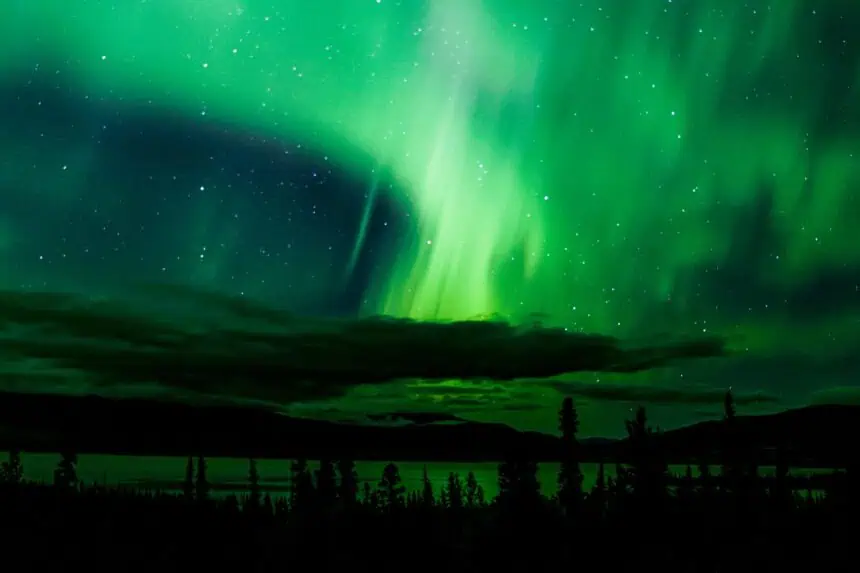
Tonight’s activity corresponds to a Kp index of 5, which indicates a G1 (Minor) geomagnetic storm. At this level, the auroral oval often expands well beyond its typical Arctic boundaries. Skywatchers across high-latitude U.S. regions may witness shimmering green and violet bands, pillars, or waving curtains of light.
“The aurora will move further from the poles, it will become brighter, and there will be more motion and structure,” NOAA meteorologists reported. Effects from the recent CME are expected to shift toward high-speed solar wind stream (HSS) activity, potentially sustaining geomagnetic unrest through Friday, June 6.
Short-term forecasts and how to track the aurora
Given the unpredictable nature of auroral displays, real-time monitoring tools are essential. NOAA offers a 30-minute aurora forecast, and enthusiasts can also use the Glendale App, both powered by live data from NASA’s DSCOVR and ACE satellites, stationed approximately 1 million miles from Earth. These sensors track solar wind speed and magnetic field direction, offering brief but crucial warning time before auroras peak.
Why Northern Lights happen
Auroras are triggered when charged solar particles interact with Earth’s magnetic field, spiraling toward the poles and colliding with atmospheric gases. These collisions energize oxygen and nitrogen atoms, causing them to emit glowing light—a phenomenon most commonly seen in Arctic skies, but occasionally pushed southward during intense solar activity.
Capturing the aurora on camera
Even when barely visible to the naked eye, tonight’s display might still show up clearly on modern smartphones. Use Night Mode if available, stabilize the device with a tripod or solid surface, and opt for RAW format when possible. These settings enhance the visibility of faint green and purple hues, which often appear as dull white glows to unaided vision.
Tonight’s aurora display could be one of the more widespread of the month, so if you’re in a dark northern area of one of the highlighted states, keep an eye on the sky after sunset.