
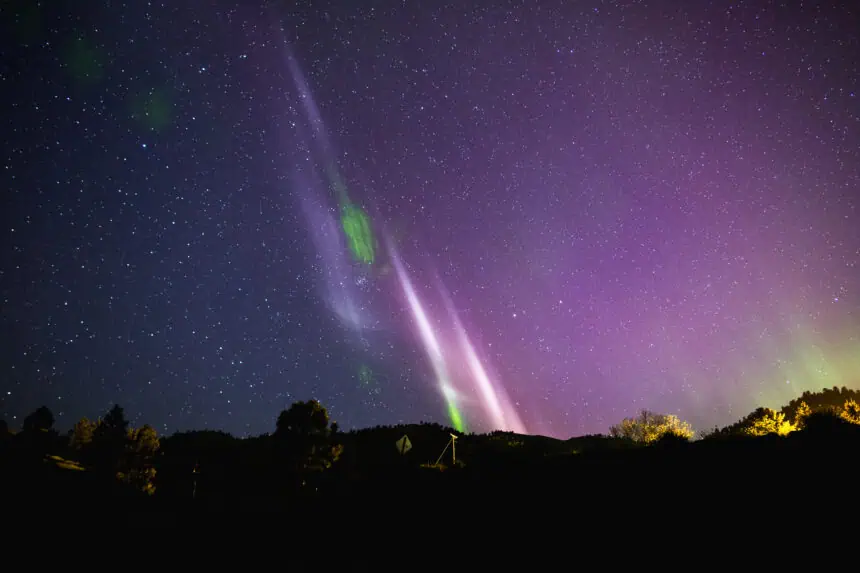

Sunday, June 9, 2025 — NEW YORK — Tonight, northern states across the U.S. may be treated to a rare and vivid display of the aurora borealis, as a minor geomagnetic storm brings the northern lights into view far beyond the usual Arctic latitudes.
Why tonight’s aurora is special
According to the National Oceanic and Atmospheric Administration (NOAA), tonight’s geomagnetic storm has a Kp index of 5, placing it within the “minor storm” G1 category. This level is strong enough to produce clear auroras in skies across higher latitudes and possibly some lower-latitude regions, depending on local weather and light pollution conditions.
These Kp-5 events often deliver brilliant green and violet waves in the sky, visible without special equipment from suitable dark areas. Although the G1 classification implies only minimal risk to power grids and satellites, the main attraction is visual: brighter, highly visible auroras for much of the northern part of the continent.
States most likely to see the northern lights
The aurora forecast map places almost all of Alaska and Canada within the high-probability visibility zone. In the United States, northern and northeastern regions are best positioned.
Strong visibility chances are expected in:
Washington, Montana, North Dakota, and Minnesota.
Areas along the southern edge of NOAA’s view line may also catch a glimpse under the right conditions. These include:
Idaho, South Dakota, Nebraska, Iowa, Wisconsin, Michigan, New York, New Hampshire, Vermont, and Maine.
Aurora activity is forecast to weaken by Monday night, when only about six states are projected to remain within the visibility zone.
Best time and place to watch
The ideal viewing window is from 10:00 p.m. to 2:00 a.m. local time, when the geomagnetic activity is typically strongest. For the best experience:
Seek dark skies, away from urban light pollution.
Head north and try to find a higher elevation like a hill, open field, or lakeside.
Cloudless conditions are essential—check your local forecast for sky clarity.
How to photograph the aurora borealis
Photographers suggest using a wide-angle lens with a tripod to reduce shake. An aperture value of 4.0 or lower will allow more light into the camera, which helps capture the aurora’s movement and detail.
Smartphone users—especially with iPhones—should switch to night mode, and frame shots to include trees, mountains, or water reflections for added composition.
Background: why auroras are surging now
The Sun is currently in its “solar maximum”, a peak in its 11-year cycle, leading to heightened solar flare activity. In fact, 2024 marked a 500-year high in auroral events according to NASA, and experts forecast continued strong geomagnetic storms through the remainder of 2025.
In May 2024, powerful solar flares caused rare auroras visible across all 50 U.S. states, an event not seen in decades. Tonight’s auroras are part of that same high-activity solar pattern, though with less intensity than the record-breaking May flares.
Stay tuned for more updates as aurora activity continues during this exceptional solar cycle.