

Minor geomagnetic storms expected Monday evening
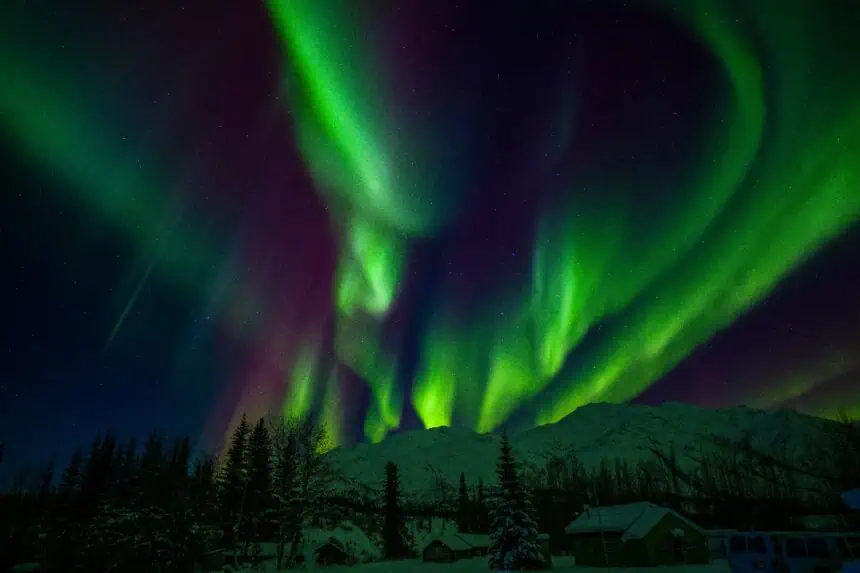
Tonight, Monday, June 17, skywatchers across the northern United States may be treated to a rare and dazzling display of the aurora borealis, as minor geomagnetic storms are forecast to occur due to increased solar wind activity, according to the National Oceanic and Atmospheric Administration (NOAA).
The NOAA’s Kp index, a scale used to measure geomagnetic activity (from 0 to 9), is projected to peak near level 5 this evening. That level suggests a visible aurora may extend unusually far south, allowing those in several U.S. states to potentially witness the northern lights with the naked eye.
Where the northern lights might appear
Forecasts indicate that the best chances for auroral visibility lie across Alaska and much of northern Canada, but NOAA also expects the shimmering lights to be possible across parts of:
South Dakota,
Wyoming,
Iowa,
New York,
New Hampshire,
Vermont,
Maine, and
Upper Michigan.
There is a lower but notable chance of visibility in northeastern Washington, northern Idaho, Montana, North Dakota, and northern Wisconsin. The Monday night forecast map released by NOAA highlights the potential visibility line drifting further south than typical during standard auroral activity.
What’s causing this auroral event
This geomagnetic disturbance stems from high-speed solar wind streams flowing from a coronal hole — a cooler and less dense region on the Sun’s surface. These winds interact with Earth’s magnetosphere, exciting oxygen and nitrogen molecules in the upper atmosphere, which then release their energy as light — creating the northern lights.
The current uptick in solar activity aligns with a forecasted solar maximum, expected to peak around late 2024 to early 2025, increasing the frequency of solar flares and coronal mass ejections that drive geomagnetic phenomena.
Ideal time and conditions for viewing
The best viewing window is projected to fall between 10:00 p.m. and 2:00 a.m. local time. To enhance your chances, NOAA recommends heading to a dark location, far from city lights and ideally at a higher elevation.
Tips for photographing the aurora
To capture the display, photography experts recommend using a wide-angle lens, with a low aperture (f/4 or lower), and setting the focus to infinity. If using a smartphone, enabling night mode and mounting the device on a tripod can help stabilize and enhance your shot.
Stay alert throughout the evening — visibility will vary based on cloud cover and local light pollution, but with the current solar conditions, parts of the Northeast, Midwest, and even the Northern Plains could be in for a celestial show rarely seen at these latitudes.