

NEW YORK – A Geomagnetic Storm Watch has been issued by NOAA, warning of minor (G1) to moderate (G2) geomagnetic storm activity expected between Wednesday, June 25 and Thursday, June 26, 2025. This atmospheric disturbance, caused by a high-speed solar wind stream, may lead to spectacular views of the Northern Lights as far south as New York, Wisconsin, and Washington state.
What’s causing the geomagnetic storm this week
Forecasters at NOAA’s Space Weather Prediction Center have identified a significant coronal hole on the Sun’s surface—a cooler, less dense region of plasma—which is currently emitting a high-speed stream of charged particles. These coronal hole high-speed streams (CH HSS) are known to interact with Earth’s magnetosphere, potentially triggering auroral activity across the northern United States.
A NASA SDO satellite image taken on June 25, 2025, shows these distinct dark patches on the Sun, indicating areas of reduced plasma density. The recurrent, negative polarity of this particular CH HSS is enhancing its effects, prompting NOAA to place the geomagnetic storm risk at G1 to G2 levels on their five-point scale.
Where and when to see the aurora borealis
If you’re in New York, Wisconsin, or Washington state, there’s a real possibility of seeing the Northern Lights from late Wednesday night into early Thursday morning. Areas in the Upper Midwest and along the northern tier of the U.S. stand the best chance—especially those far from urban light pollution.
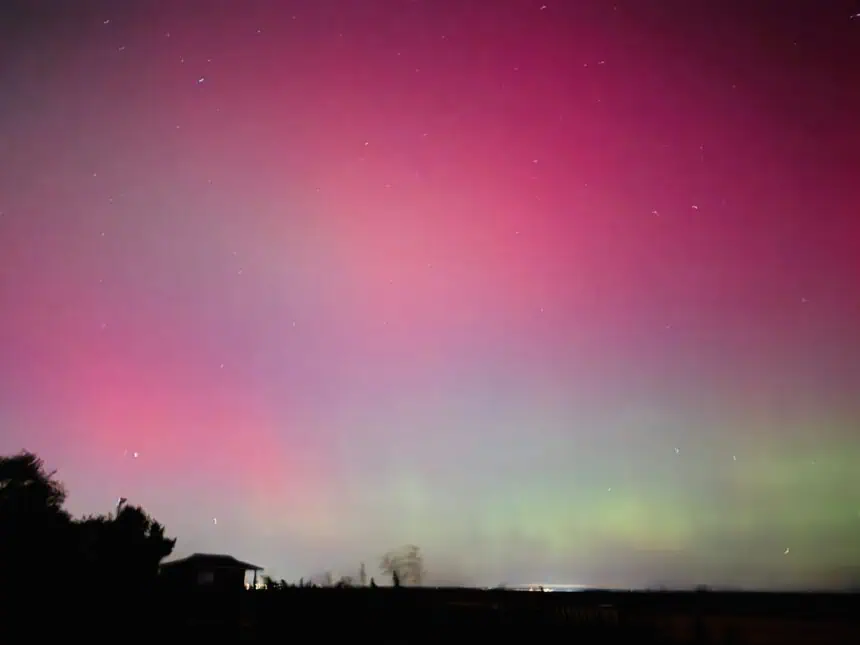
This week’s geomagnetic activity could transform night skies into vivid displays of green, pink, and purple light, resembling waves or flames across the horizon. While severe (G4) storms can push the aurora visibility zone as far south as the Gulf Coast, the current forecast supports visibility mainly across the northern United States.
How to maximize your aurora viewing chance
Find a dark, open area facing north, well away from city lights. Even if the aurora isn’t visible to the naked eye, a smartphone in night mode could reveal stunning colors and motion in the sky.
Astronaut Don Pettit recently captured breathtaking footage of the Northern Lights from the International Space Station while approaching a Soyuz spacecraft on April 8, 2025, underscoring just how dramatic this solar interaction can be.
With the heat dome continuing to grip much of the United States, this rare celestial spectacle may offer a brief visual escape—a cooling show above the blazing landscape below.