
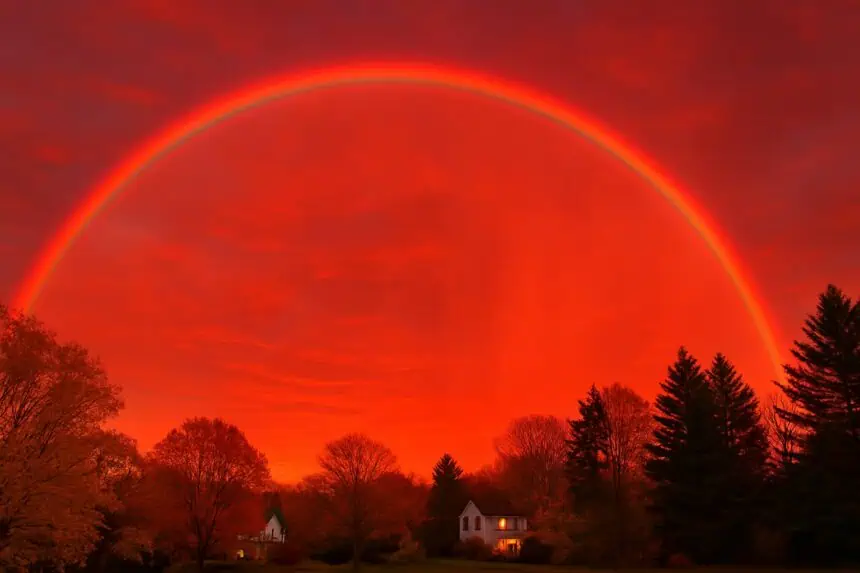

MARLBORO, Massachusetts – On Tuesday, July 1, just after sunset, a rare and stunning weather phenomenon captured the attention of residents across Central Massachusetts: a completely red rainbow, caught on camera by Carter Roy.
“I was just heading to my basketball league that I play in on Tuesdays and Thursdays down in Marlboro,” Roy said. “The storms had just passed us, and the sky was pretty wild. Then I noticed a rainbow starting to form.”
Within minutes, the arc stretched fully across the sky, but something even more unusual happened — the rainbow turned bright red, visible only for a brief moment before fading.
“All of a sudden, it went from day to night,” Roy said. “It was right around dusk, and the sunset was behind me, which I think made the lighting feel so surreal.”
Roy happened to be in the exact right place at the right time to witness a relatively rare meteorological event known as a red rainbow or monochrome rainbow. Unlike typical rainbows that display a full spectrum of colors, this type only shows shades of red, orange, and pink.
Michael Person, director of the MIT Wallace Astrophysical Observatory and senior lecturer in Earth, Atmospheric and Planetary Sciences, explained, “A rainbow forms when sunlight is refracted through small water droplets in the atmosphere. As the light passes through, it spreads out into its component colors.”
The light bends at a specific angle, creating the arc we see, with colors typically ranging from red to violet. Rainbows appear on the opposite side of the sky from the sun, at what’s called the “anti-solar point.”
For a rainbow to appear in red hues only, several conditions must come together.
“It happens at very low altitude, right above the horizon, when the sun is just rising or setting,” Person said. “As the sun gets lower, the sky turns red — that familiar sunset glow. The same thing happens to the rainbow.”
At that angle, the thick atmosphere filters out all colors except red. The result is a low-lying red arc that forms opposite the setting sun.
Rainbows don’t appear in other monochrome colors, Person added, noting that for a green rainbow to exist, the atmosphere would need to scatter everything except green — “and we simply don’t have that in our atmosphere.”
Red rainbows are most commonly seen during this time of year, from late spring through early summer, when storms pass quickly, leaving behind enough lingering moisture and clear skies to let sunlight shine through, Person said.
“I wouldn’t call the red rainbow rare,” Person noted, “but you do have to get lucky. The conditions need to line up — you need the rain, the sun, and enough water droplets in the air on a clear horizon for the effect to appear at all.”