
 Weather pattern for Winter 2025/2026 shows early signs of disruption
- What the Polar Vortex is and why it matters
- Three global signals fueling the breakdown
- ENSO trends: La Niña may tip the scale
- High-altitude winds: The QBO connection
- Arctic sea-ice: A crucial piece of the puzzle
- Stratospheric temperature signals: Warming underway
- What this could mean for the United States
As of Wednesday, July 9, 2025, meteorological indicators are strongly pointing toward a weaker-than-average Polar Vortex for the upcoming Winter 2025/2026. This subtle yet powerful shift in the upper atmospheric circulation could translate into increased weather variability across the United States, particularly for regions like the Northeast, the Midwest, and parts of the South.
What the Polar Vortex is and why it matters
The Polar Vortex refers to the massive low-pressure system circulating around the Arctic high in the stratosphere. It governs cold air containment near the poles and influences the jet stream. When this vortex is strong, it keeps cold air locked in the north. But when it weakens, the jet stream can become highly erratic, dipping far southward and allowing Arctic air to sweep into the continental U.S.
A weak or disrupted Polar Vortex is typically associated with more frequent cold outbreaks, snowstorms, and blocking patterns that lock in extreme temperatures. Based on current stratospheric dynamics, such a scenario appears increasingly likely this winter.
Three global signals fueling the breakdown
The potential weakening of the Polar Vortex is being driven by three major global patterns now aligning for Winter 2025/2026: ENSO conditions, the Quasi-Biennial Oscillation (QBO), and Arctic sea-ice anomalies.
ENSO trends: La Niña may tip the scale
The Pacific Ocean is transitioning from neutral ENSO conditions toward a weak La Niña, as indicated by cooler-than-normal sea surface temperatures in the tropical Pacific. This has historically increased the likelihood of a Sudden Stratospheric Warming (SSW) event by 60–75%, especially in the second half of winter.
Forecast models, including the NMME, are projecting cool anomalies in the Pacific as we move through October and November, suggesting that La Niña may strengthen modestly heading into December. This kind of ocean-atmosphere coupling can disrupt tropical convection patterns, sending planetary waves poleward that disturb the stratospheric circulation.
High-altitude winds: The QBO connection
The QBO, a regular oscillation of stratospheric winds over the Equator, is now entering its easterly (negative) phase. Data from NASA and radiosonde observations over Singapore confirm that these easterly winds are now propagating downward into the lower stratosphere, just in time to interact with the developing winter vortex.
This matters because easterly QBO phases create more favorable conditions for vertical wave propagation, which can help weaken or even collapse the Polar Vortex. This phase also intensifies the coupling between ENSO and the Arctic circulation, making the overall system more sensitive to both oceanic and atmospheric triggers.
Arctic sea-ice: A crucial piece of the puzzle
Perhaps the most striking indicator so far is the current sea-ice extent in the Barents and Kara Seas, which remains well below average. At the same time, ice in the Sea of Okhotsk is exceptionally high—a rare and impactful combination.
Recent studies show that low sea-ice in the Barents/Kara region reduces near-surface pressure, boosting planetary wave energy that can be directed upward into the stratosphere, where it destabilizes the Polar Vortex. Conversely, higher ice coverage in the Okhotsk Sea acts as a stabilizing force—but in this configuration, the Barents/Kara signal dominates.
The situation is further amplified by the ongoing easterly QBO phase, which enhances the vertical energy transport initiated by Arctic ice anomalies. The atmospheric setup is beginning to resemble previous winters that were defined by major Stratospheric Warming events, especially those in 2018 and 2021, both of which saw significant cold outbreaks across the United States.
Stratospheric temperature signals: Warming underway
Already this year, a Sudden Stratospheric Warming event was observed in March, leading to a temporary collapse of the Polar Vortex and triggering late-season cold surges across North America. While such events are more common from December through February, the current high-latitude temperature trends in the stratosphere hint at elevated pressure and warming, both of which are precursors to vortex disruption.
Early forecasts from the ECMWF long-range model also indicate a possible weak vortex signature emerging by late November, consistent with the oceanic and atmospheric cues now developing.
What this could mean for the United States
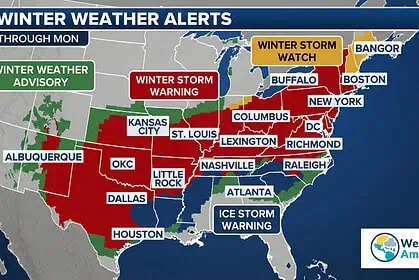
Should the Polar Vortex weaken as forecasted, regions across the U.S.—especially the Northeast, Great Lakes, and Central Plains—could face more persistent cold spells, with increased snowfall potential compared to recent winters. The West Coast could also experience greater storm activity, depending on how the jet stream pattern evolves.
Everything is still highly sensitive to the evolution of ENSO and QBO over the next several weeks. However, the current global alignment is shaping up to favor instability in the polar circulation, which often unleashes colder, stormier conditions across North America by mid-winter.