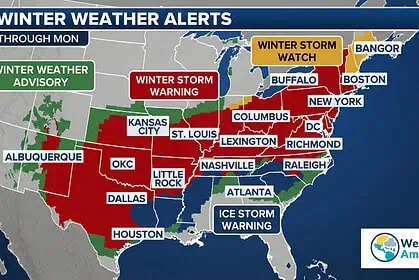


NEW YORK – It may be July, but the conversation around deep winter freezes in the United States is heating up. Despite the backdrop of global warming, scientists have identified significant changes in the polar vortex—a shift that’s increasingly triggering arctic blasts across large parts of the U.S., including Texas, Oklahoma, the Midwest, and the East Coast.
A recent study reveals that the polar vortex, typically a stable zone of low pressure spinning above the Arctic, is becoming unstable and more likely to stretch and wobble, sending bitter cold down into North America. These so-called “stretch events” have been rising in frequency since the 1980s, unleashing sudden cold snaps, extreme snowfalls, and widespread damage—like the 2021 Texas freeze that caused over $1 billion in losses.
According to Judah Cohen, director of seasonal forecasting at Atmospheric and Environmental Research and visiting scientist at MIT, these shifts aren’t rare anomalies anymore—they’re part of a growing pattern. “Extreme cold, intense snowstorms, and deep snowpacks are overwhelmingly connected to these polar vortex stretch events,” Cohen explained.
The research team analyzed satellite data and weather records from 1980 to 2021, identifying five distinct stratospheric patterns in the atmosphere’s middle layer, about 12 miles (19 kilometers) above Earth. Two of these patterns are strongly linked to freezing air cascading into Canada and the U.S. during stretch events. One tends to impact the East Coast, while the other cools down the Midwest and Plains.
Interestingly, since 2015, the westerly pattern—which favors colder air over the central U.S.—has become more dominant, a change potentially influenced by La Niña, the climate phase known for its cool Pacific waters. Recent years have seen multiple multiyear La Niña events, which may be amplifying this effect.
Andrea Lopez Lang, an atmospheric scientist at the University of Wisconsin–Madison, noted that this research could be key for industries tied to energy, insurance, and infrastructure, especially in regions where frozen pipes, energy demand spikes, or weather claims can overwhelm systems. “Understanding these patterns may not solve everything,” she said, “but it offers new potential for longer-range forecasts.”
While the polar vortex usually spins like a stable top over the North Pole, it occasionally collapses, sending arctic air toward northern Europe, Asia, and sometimes North America. Yet, these collapses don’t always guarantee a cold spell for the U.S., which has left a lingering question: why do some years bring more dramatic winter events to America than others?
Cohen’s team believes they may have found part of the answer. The polar vortex doesn’t only collapse—it also wobbles and stretches without falling apart. These weaker but more frequent disruptions might be the real culprit behind the increasing number of U.S. cold spells.
As the Arctic warms and sea ice melts, new atmospheric waves are forming, particularly over Eurasia, where contrasting zones of warmth and cold further destabilize the vortex. These standing waves are now strong enough to alter stratospheric behavior, making cold air incursions more common.
But there’s a twist: if the Arctic sea ice continues to disappear, that destabilizing wave could weaken and flip the entire dynamic. Instead of surprise deep freezes, the Northern Hemisphere might shift toward milder winters, resembling the relatively stable climate of the Southern Hemisphere, where polar vortex breakdowns are exceedingly rare.
In that future, midlatitude cities across the U.S. might face fewer cold spells, while the Arctic itself could remain permanently frigid.
This evolving dance of stratospheric forces suggests that climate change isn’t just warming the globe—it’s restructuring winter itself.