

A unique celestial show over northern U.S. skies
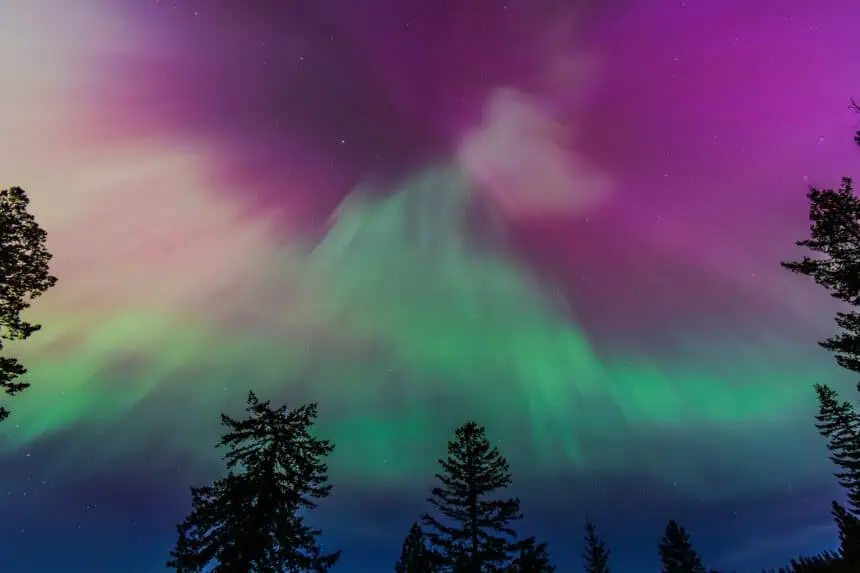
Friday, May 23, 2025 — Skywatchers across parts of the northern United States may catch a glimpse of the northern lights tonight, as space weather forecasters predict the possible arrival of a coronal mass ejection (CME) that left the Sun on May 17. According to the National Oceanic and Atmospheric Administration (NOAA), geomagnetic activity could reach G1 (Minor) storm levels, which would make aurora borealis visible in select areas along the U.S.-Canada border.
What’s causing the aurora activity tonight
A coronal mass ejection, or CME, is essentially a vast cloud of electrified gas and magnetic fields released from the Sun’s surface. This particular event was likely triggered by a solar flare, an explosive burst of radiation. While there remains uncertainty about whether the CME will actually strike Earth’s magnetic field, NOAA warns that a glancing blow is possible, especially considering the presence of a large coronal hole currently facing Earth. Coronal holes are regions of the Sun’s outer atmosphere, or corona, where magnetic field lines open out into space, allowing solar wind to escape more freely — a known driver of auroral activity.
Expected viewing areas across the United States
Should this geomagnetic storm materialize, tonight’s aurora borealis may be visible under clear skies in parts of:
Washington, northern Idaho, Montana, North Dakota, South Dakota, Minnesota, Wisconsin, Michigan, and Maine.
This forecast is driven by NOAA’s aurora model, which currently predicts a Kp index of 4. That level suggests a modest expansion of auroral visibility beyond the polar regions, potentially delivering vibrant, moving light displays to these northern states.
What makes this timing significant
The Sun is currently around the peak of its 11-year solar cycle, known as the solar maximum, which intensifies solar activity like flares, CMEs, and coronal holes. Since October 2023, the Sun has shown signs of reaching this peak, and earlier this year, a G5 geomagnetic storm in May 2024 created one of the most powerful auroral events in recent history — the strongest since 2004.
As Earth remains in the path of turbulent solar wind streams, especially from the current coronal hole, even moderate storms can produce eye-catching auroras well beyond typical polar latitudes.
Stay informed
Real-time updates and the latest 30-minute aurora forecasts are available directly from NOAA, offering valuable insight into the best viewing times and potential visibility zones. Observers in the highlighted states should look northward late tonight and hope for cloud-free skies to witness this rare and mesmerizing natural phenomenon.