
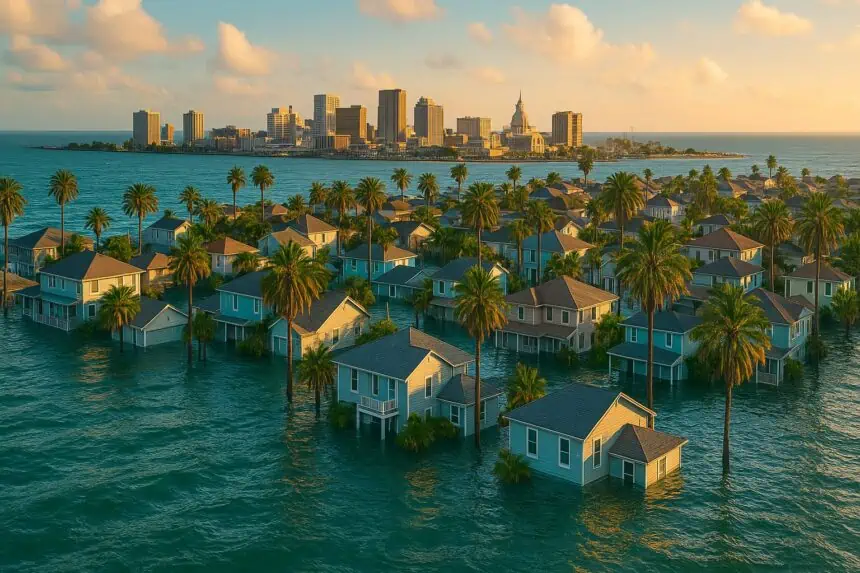
 Rockport, Galveston and Port Isabel facing growing threat
Several coastal cities in Texas are now at the forefront of accelerating sea level rise, according to a 2024 study from the Virginia Institute of Marine Science, which examined 55 years of tide gauge data from 36 U.S. coastal communities. This shift is being closely tracked due to its implications for infrastructure, housing and long-term urban planning in the Gulf Coast region.
Record-breaking rates along the Texas coast
The city of Rockport currently reports the highest sea level rise in the United States, with water levels climbing at 7.1 millimeters per year. Close behind is Galveston, experiencing an annual rise of 6.8 millimeters, and Port Isabel, which is seeing an increase of 5.2 millimeters per year. All three cities are situated directly on the Gulf of Mexico, where they face a confluence of oceanic and atmospheric pressures that intensify local sea level dynamics.
Why Texas is more exposed than Florida
While sea levels are rising across the U.S., Texas cities are seeing a much sharper increase than similar coastal communities in Florida. For example, Pensacola and Cedar Key are both reporting less than 4 millimeters per year, and even Key West — an island community further out to sea — sees only 3.6 millimeters annually, roughly half the rate observed in Rockport. This disparity underscores how local geological and oceanographic factors, including land subsidence and erosion, can compound global trends.
What’s driving the change
According to Piper Wallingford, a climate resilience scientist at The Nature Conservancy, the primary drivers behind the current sea level increases are thermal expansion — where warmer water occupies more volume — and the melting of glaciers and ice sheets due to global warming. While these changes occur globally, Texas’s coastal profile and local subsidence contribute to a more dramatic rise than in many other states.
What this means for urban life
As sea levels continue their upward trajectory, cities along the Texas coast may face increasingly frequent and intense flooding, potentially causing coastal erosion, infrastructure damage, and even the displacement of entire communities. The dense populations and critical energy infrastructure in this region make it particularly vulnerable to disruption, especially if adaptation strategies fall behind the pace of environmental change.
The situation unfolding in Rockport, Galveston and Port Isabel is not just a regional concern—it represents a microcosm of the broader climate risks facing the United States.