

When the monsoon season begins in Arizona
The official start of the Arizona monsoon season is June 15, and it runs through September 30. However, this date is primarily used for public awareness—it doesn’t mean storms will begin immediately.
The monsoon is defined by a shift in prevailing winds, which begin to pull moist air into Arizona from the Gulf of California, the eastern Pacific Ocean, and occasionally the Gulf of Mexico. These new wind patterns, typically from the southeast, bring higher humidity and set the stage for the classic summer thunderstorms that characterize this season.
According to Michael Crimmins, a climatologist from the University of Arizona, forecasting the monsoon remains challenging. He described the climate models for 2025 as effectively “shrugging,” meaning they provide little predictive confidence. As of early June, the El Niño–Southern Oscillation (ENSO) pattern has returned to neutral, offering no strong guidance about monsoon behavior.
How monsoon storms develop
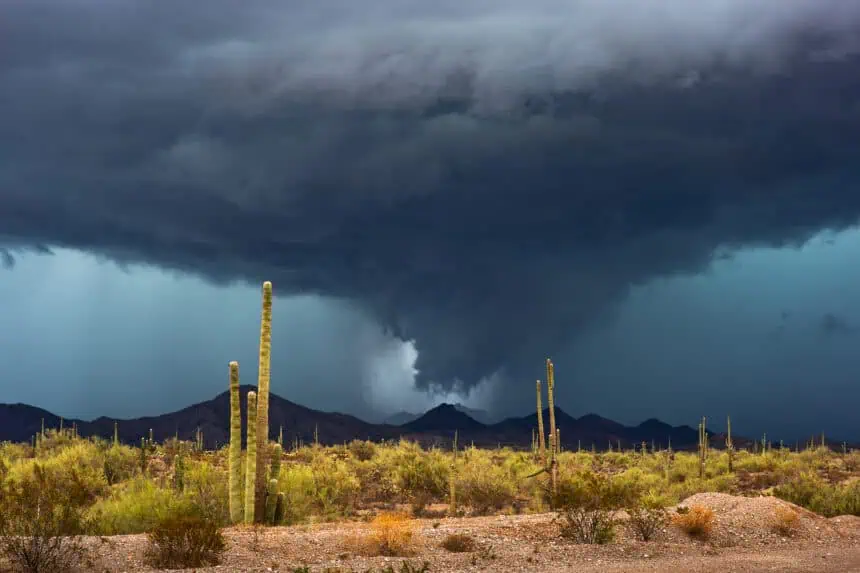
Monsoon storms form when three key ingredients align: moisture in the atmosphere, rising warm air, and atmospheric instability. This process often begins with the subtropical ridge of high pressure moving over the Four Corners region, causing a reversal in wind direction and pulling in humid air from nearby warm oceans.
As dew point temperatures rise, clouds develop. If the atmosphere is unstable enough, these clouds can grow into powerful thunderstorms. However, even when conditions seem ideal, not all storms travel beyond the mountains to reach lowland areas like Phoenix or Tucson. Some dissipate before impacting metro regions, especially without enough mountain-driven outflow to help push them across the desert floor.
What to expect in Phoenix during the 2025 monsoon
In 2025, Phoenix and surrounding low-desert areas are expected to receive approximately 2 inches (about 5 cm) of rainfall. The historical average for the Phoenix area between 1991 and 2020 was 2.43 inches (6.17 cm). Although this is a modest total, it is significant for a desert city.
This year, the National Weather Service has assigned Phoenix a:
- 43% chance of above normal precipitation
- 33% chance of near normal precipitation
- 24% chance of below normal precipitation
Mountain regions, such as those near Flagstaff or Show Low, could see up to 16 inches (40.6 cm) of rainfall during the season and experience 30 to 50 days of rain. In contrast, metro Phoenix typically logs around 10 days with measurable rain during the monsoon.
Other cities in Arizona like Tucson, Prescott, Kingman, and Flagstaff are also leaning toward above-normal monsoon rainfall this year, potentially offering relief after a dry winter and the disappointing 2024 monsoon.
Keep in mind: while the monsoon season may officially begin mid-June, the first thunderstorms may not arrive until late June or early July, depending on the movement of moisture, high-pressure systems, and local conditions.