
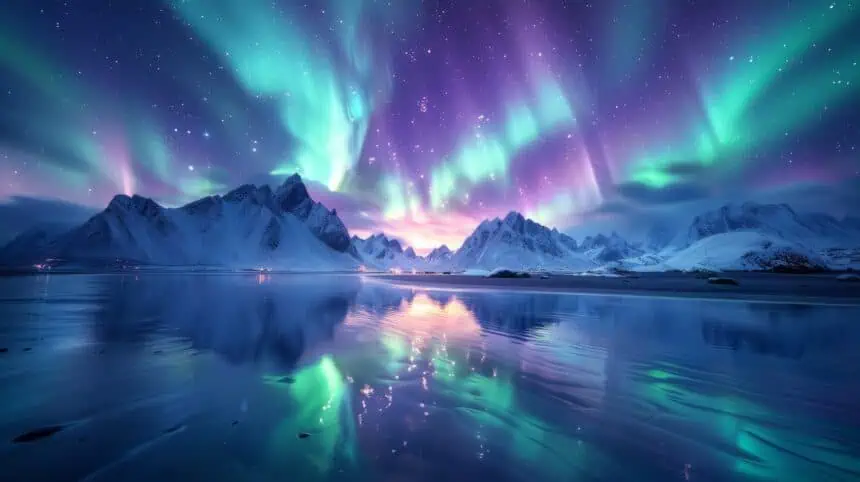

A rare geomagnetic storm is expected to paint the sky with vivid colors tonight across a large part of the United States, as the Northern Lights, or aurora borealis, may become visible far beyond their usual range. Forecasts from the National Oceanic and Atmospheric Administration (NOAA) suggest that at least 15 states could experience this spectacular phenomenon.
A geomagnetic push brings auroras farther south
This evening, the auroral activity is forecast to reach a Kp index of 5 on a scale of 9. That level signifies moderate geomagnetic storm conditions, strong enough to push the dancing lights into more southern latitudes than usual. This follows a week of solar activity, including a solar flare and high-speed solar winds coming from a cooler, less dense coronal hole on the sun’s surface.
NOAA also anticipates that Thursday night could see similar activity, although early forecasts suggest the Kp index might drop slightly to around 4, reducing visibility chances further south.
Where to see the Northern Lights tonight
According to the latest aurora forecast, the minimal view line dips as far south as northern Iowa, with the strongest and clearest views expected in northern Canada and Alaska. However, several U.S. states are in for a possible visual treat under the right sky conditions. These include:
Washington, northern Idaho, Montana, northern Wyoming, North Dakota, northern South Dakota, Minnesota, Wisconsin, Upper Michigan, New York, Vermont, New Hampshire, and Maine.
The best viewing time is between 10:00 p.m. and 2:00 a.m. local time, ideally from a high, dark vantage point away from urban light pollution.
Tips for photographing the aurora borealis
For those hoping to capture the moment, NASA advises:
-
Smartphones: Enable night mode, turn off the flash, and use a tripod to prevent image blur.
-
DSLR or mirrorless cameras: Use a wide-angle lens, set the aperture (F-stop) to 4 or lower, and focus to infinity for the best sharpness.
A glowing cycle through 2026
Tonight’s auroras are part of a broader pattern. Both NASA and NOAA have noted that solar activity peaked in 2024, which means frequent auroras are expected to continue into early 2026. When electrons from the sun’s solar flares or coronal mass ejections smash into oxygen and nitrogen in Earth’s atmosphere, they become “excited” — releasing that energy in the form of the vibrant light shows we call the northern lights.
So, if you’re in one of the highlighted states and have clear skies, tonight might offer a rare and unforgettable glimpse of celestial color across the American sky.