

Where and when to watch the aurora in the United States
Tuesday, June 24, 2025 – New York, 10:00 AM (EDT) — The Northern Lights are returning to the continental United States tonight, with a renewed forecast from NOAA (the National Oceanic and Atmospheric Administration) indicating a heightened chance of aurora sightings in 14 U.S. states. A minor geomagnetic storm—rated G2 on a five-level scale—is expected to intensify after sunset on Tuesday, June 24, and into the early hours of Wednesday, June 25.
According to NOAA’s Space Weather Prediction Center, the Kp index—a standard measurement of geomagnetic disturbance—may reach level 5, enough to generate visible auroras on the northern horizon in several states far beyond the usual viewing zones.
Why the aurora is intensifying this week
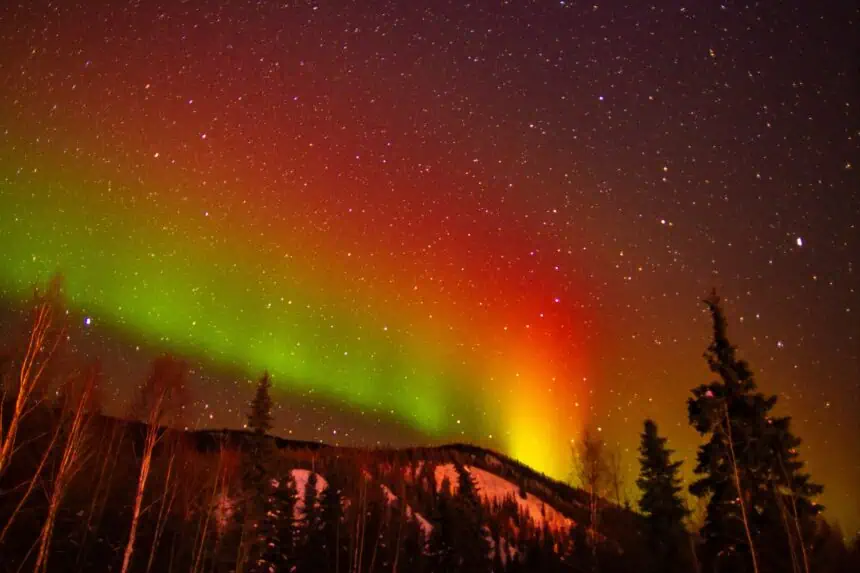
This celestial activity is linked to a large coronal hole on the Sun, which has turned to face Earth and is releasing a fast-moving stream of solar wind. As this wind collides with Earth’s magnetic field, it can trigger auroras that glow in shades of green, purple and sometimes red.
Which U.S. states have a chance to see the Northern Lights
If skies remain clear and light pollution is minimal, residents in parts of Washington, northern Idaho, Montana, Wyoming, North Dakota, South Dakota, Minnesota, Wisconsin, Michigan, Iowa, New York, Vermont, New Hampshire, and Maine could witness the aurora borealis low on the northern horizon.
Those closer to the U.S.–Canada border—particularly in rural areas and national parks—will have the highest chance of spotting the display. Views may begin as early as 10:00 PM local time, depending on exact location and solar wind strength.
What time and how to track aurora visibility
While forecasts offer general predictions, real-time alerts will come from NASA’s DSCOVR and ACE satellites, located nearly 1 million miles from Earth. These satellites monitor the solar wind’s speed and magnetic orientation, offering about 30 minutes’ warning before auroras ignite in the sky.
To track the aurora’s progress tonight, you can use NOAA’s 30-minute forecast tool or specialized aurora apps such as Glendale, which update in near real-time.
What causes the Northern Lights to appear so far south
The Northern Lights, or aurora borealis, are created when charged particles from the Sun interact with oxygen and nitrogen atoms in Earth’s upper atmosphere. These particles are funneled by Earth’s magnetic field toward the polar regions, where they collide with atmospheric gases, causing them to glow.
Currently, we’re near the peak of Solar Cycle 25, known as the solar maximum—a phase of heightened solar activity that hasn’t been this intense in over two decades. This spike in solar storms is making it possible for the aurora to be seen much farther south than usual, and experts expect increased aurora events throughout 2025 and into 2026.