
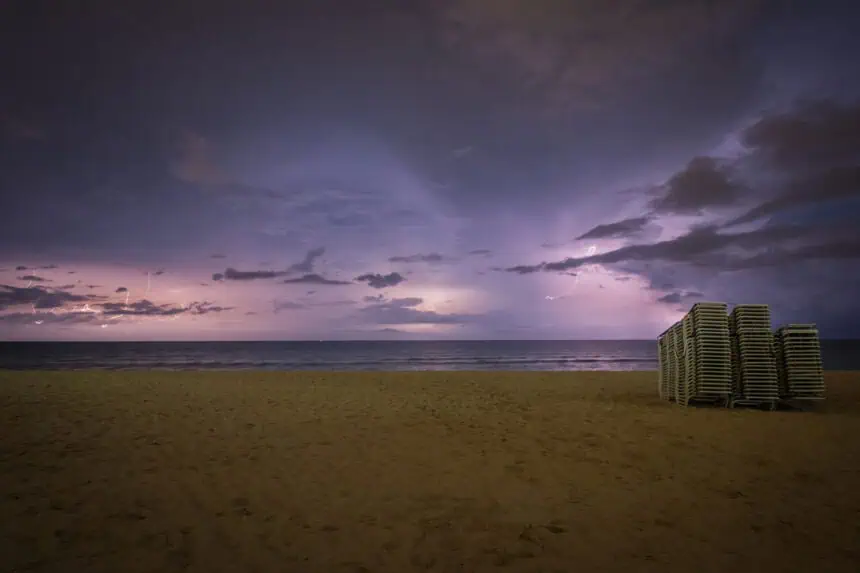

Weather conditions on Thursday, July 4, are turning increasingly unstable across the southern half of the state of Florida, as a tropical disturbance near the Gulf Coast intensifies. Both Miami and Tampa are facing a wet and stormy Independence Day, with frequent downpours, thunderstorms, and urban flooding risks expected throughout the day.
Unstable pattern settles over South Florida
As of this morning in Miami, the National Weather Service (NWS) issued warnings for scattered to widespread thunderstorms driven by the combination of a stationary front over northern Florida and a deep flow of tropical moisture from the Atlantic.
Across Miami-Dade, Broward, and Palm Beach counties, storm chances today range between 70% and 90%, with the highest risk during the afternoon and early evening hours. High temperatures will top out around 88 °F (31 °C), but heat indices could rise close to 100 °F (38 °C) due to humidity and low wind circulation.
Localized rainfall totals may exceed 5 inches (125 mm) in urban coastal areas, particularly where slow-moving or stationary thunderstorms take hold. This scenario raises concerns over flash flooding, especially in cities like Fort Lauderdale, Pembroke Pines, Boca Raton, and West Palm Beach, all under an 80% to 90% chance of rain today.
Meteorologists note that cloud cover throughout the day will limit sunshine and help keep afternoon highs relatively steady, but surface heating will still be enough to fuel convective storms.
Tampa and the Gulf Coast brace for widespread rain
On the west coast, Tampa Bay and surrounding cities are dealing with a continuing pattern of heavy rains, driven by a persistent low-pressure system and southwest wind flow off the Gulf of Mexico.
The NWS Tampa Bay office projects a 90% probability of thunderstorms developing from early morning through the afternoon, with activity following a Type 4 sea breeze pattern — storms initiating over water and pushing inland. The most intense rainfall is forecast between midmorning and early afternoon.
Tampa, St. Petersburg, Sarasota, and Fort Myers will all see highs around 86–88 °F (30–31 °C), but with dense clouds, there will be limited daytime heating. In St. Petersburg, highs may remain near 85 °F (29 °C) with consistent rainfall rates leading to minor flooding, especially in low-lying areas where soils are already saturated from previous days of rain.
Even inland towns like Lakeland and Brooksville could experience similar rainfall totals, with accumulations between 2 and 3 inches (50 to 75 mm) over the extended holiday weekend, and possibly more in thunderstorms that linger over one area.
Potential tropical development near North Florida
The National Hurricane Center (NHC) is closely tracking an area of low pressure expected to drift over northern Florida and the southeastern U.S. coast over the weekend. As of today, there’s a 60% chance this system could develop into a tropical or subtropical depression, with impacts extending into Georgia and the Carolinas by early next week.
Regardless of its classification, forecasters emphasize that deep tropical moisture is already in place and will fuel widespread showers and thunderstorm activity across South Florida through Sunday. The long-range outlooks continue to show persistent instability, suggesting a wet pattern through the remainder of the week.
Maritime and aviation impacts in South Florida
For boaters along the Atlantic and Gulf coasts, waves will generally stay near 2 feet (60 cm), though storms could produce rapid wind gusts and choppy seas in short bursts.
In the air, airports in Miami and Tampa are expecting mostly VFR (Visual Flight Rules) conditions, but visibility may temporarily decrease during thunderstorms. Southerly to southwesterly winds are forecast near 11 mph (18 km/h).
However, airlines may need to adjust schedules intermittently, especially during the afternoon hours, when electrical storm activity is likely to intensify near both cities’ terminals.
Southeast U.S. on alert
As the tropical disturbance moves north-northeast, its influence could spread beyond Florida. Heavy rainfall and embedded thunderstorms are likely to affect parts of Georgia, South Carolina, and North Carolina between Saturday and early next week, as the system is expected to transition into a tropical depression.
The NHC has highlighted the central-west coast of Florida as particularly vulnerable to flooding rains, with more widespread impacts possible along the southeastern coast of the United States in the days ahead.