
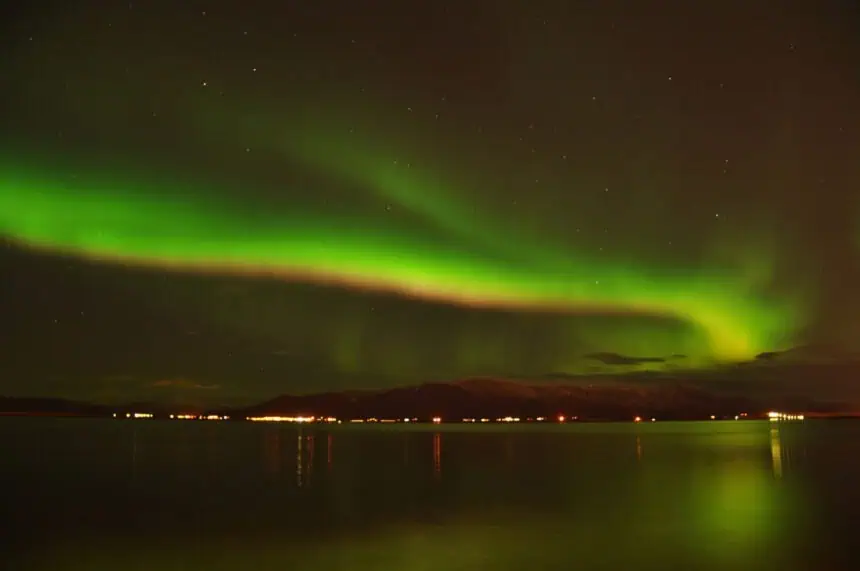
 A rare aurora sighting possible across the northern United States
On Monday night, much of the northern tier of the United States will have a strong chance to witness the northern lights, following a burst of geomagnetic activity that originated from a less dense, high-speed stream of solar wind emerging from a cooler region on the sun’s surface.
Where the northern lights will likely be visible
The NOAA forecast highlights a Kp index of 3 to nearly 4 (on a scale of 0 to 9), suggesting moderate geomagnetic activity capable of pushing the aurora farther south than usual. A Kp index of 5 was registered Sunday night into early Monday, signaling a brief but intense geomagnetic storm.
The best viewing zones for Monday night stretch across the Upper Midwest and Northeast, particularly in:
Northeastern Washington, Northern Idaho, Montana, North Dakota, Northern Minnesota, Upper Michigan, and Northern Wisconsin.
If skies remain clear, parts of South Dakota and Maine might also catch glimpses of the aurora near the horizon.
Most of Alaska and Northern Canada remain within the high-probability zone, offering even stronger opportunities for spectacular displays.
Optimal viewing time and conditions
The prime window for viewing will be between 10 p.m. and 2 a.m. local time, when skies are darkest and the aurora borealis is most active.
For the clearest experience, seek out a north-facing high vantage point with minimal light pollution. Rural areas far from city lights provide the best conditions.
Tips for photographing the northern lights
If you’re aiming to capture the moment:
- Smartphone users should activate night mode, disable flash, and reduce shutter speed to allow more light.
- DSLR and mirrorless camera users will want a wide-angle lens, an aperture (F-stop) of 4 or lower, and a focus set to infinity. A tripod is essential for long exposures.
Why this is happening now
The aurora forms when charged particles from solar activity interact with nitrogen and oxygen in the Earth’s upper atmosphere, exciting the atoms and releasing waves of visible energy in the form of dancing light.
We are currently in an active solar period, known as the solar maximum, which peaked in October 2024 and is projected to persist through early 2026. This cycle increases the frequency and strength of geomagnetic events—leading to more frequent and intense auroral displays across North America.
Notably, a historic geomagnetic storm in May 2024 dragged the northern lights as far south as Texas and northern Florida, marking the strongest solar impact in over 20 years.