

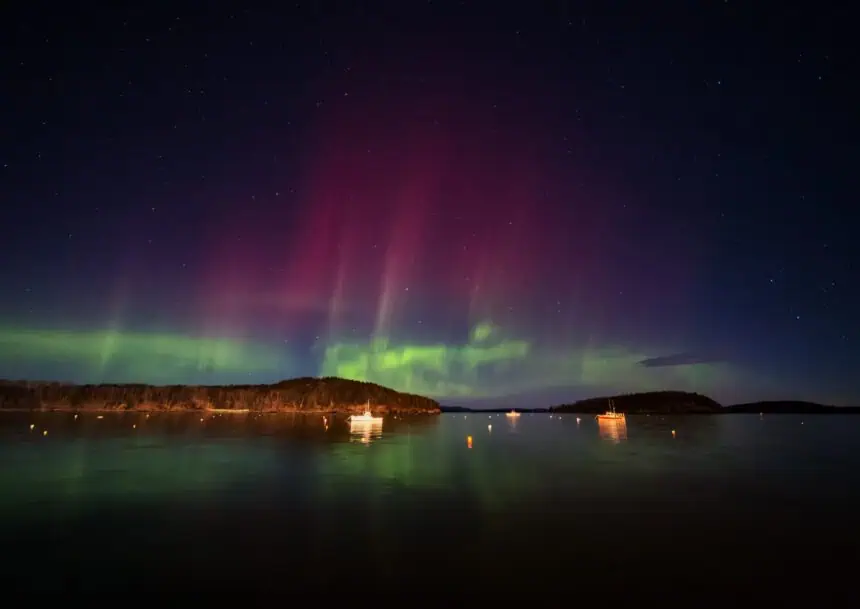

Geomagnetic storm intensifies visibility across the northern United States
Portland, Maine – A surge in geomagnetic activity has dramatically increased the chances of witnessing the aurora borealis across at least 15 U.S. states tonight, Thursday, May 30, 2025, continuing into Friday, May 31 and possibly Saturday, June 1. This phenomenon follows the detection of a G2-rated geomagnetic storm, upgraded from earlier milder forecasts by NOAA (National Oceanic and Atmospheric Administration).
Why now is a rare and ideal moment to spot the aurora
This celestial spectacle comes at a perfect time. The new moon earlier this week on Monday, May 26 has left skies especially dark, and with Earth’s axial tilt nearing its peak before the June solstice, northern latitudes across the United States are getting extended twilight hours and maximum nighttime darkness—ideal conditions to view the northern lights.
NOAA’s upgraded models indicate strong solar wind activity—triggered by a negative polarity coronal hole high speed stream (CH HSS)—hitting Earth’s magnetic field. The solar wind’s southward-pointing magnetic field has the potential to intensify auroras, bringing the light show to lower latitudes than usual.
Where you might catch the northern lights tonight
Based on NOAA’s latest aurora viewline forecast, the aurora borealis might appear overhead or in northern skies in the following states:
Maine, Michigan, Wisconsin, Minnesota, North Dakota, South Dakota, Montana, northeast Wyoming, northern Idaho, and northern Washington.
Some northern counties in Vermont and New Hampshire might also be within visual range, depending on local cloud cover and light pollution. Border areas near Canada remain your best bet due to the higher geomagnetic activity in those regions.
What’s driving this geomagnetic drama?
The space weather surge began after NOAA detected an unexpected G3-class storm in the early hours of May 29. At 02:16 UTC, a strong interaction between the solar wind and Earth’s magnetosphere sparked the alert, with effects lingering through May 30 and possibly into June 1.
Adding to the stormy space weather were intense solar flares on May 25, including an X1.1-class flare that temporarily blacked out shortwave radio signals across the Pacific Ocean, followed by M3.4 and M8.9-class flares—all signs of increased solar activity during this solar maximum cycle.
Understanding the Kp index tonight
The Kp index, which measures geomagnetic disturbances, is projected to hit Kp 4 this evening. While not extreme, it’s enough to push the auroral oval southward, making vivid auroral formations more likely in areas far from the Arctic Circle. NOAA notes that at Kp 4 and above, auroras begin to appear brighter, more dynamic, and easier to spot with the naked eye in dark-sky locations.
When and how to watch
The best window to view the aurora is typically from 10 PM to 2 AM local time, though storms can create unexpected surges before or after. Given the unpredictability of space weather, you may want to check NOAA’s real-time Aurora Dashboard or use apps like SpaceWeatherLive or Glendale App to track Kp levels and Bz magnetic readings.
Stay clear of urban light pollution, find a spot with an unobstructed northern horizon, and give your eyes at least 20 minutes to adjust to the dark. With a bit of luck—and patience—you could witness one of nature’s most astonishing light displays from your own backyard in the northern United States.