
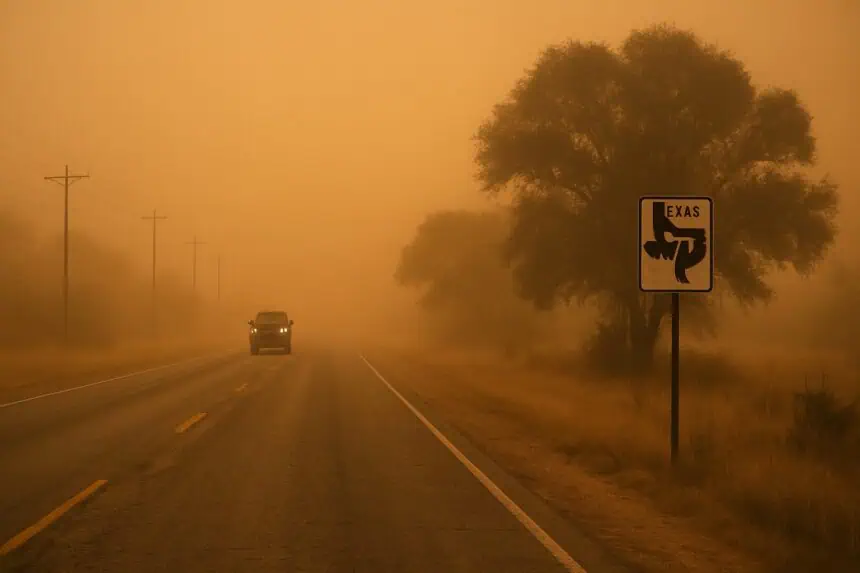

A dense plume of Saharan dust is traveling thousands of miles across the Atlantic Ocean, set to impact the weather in Texas, Florida, and much of the Gulf Coast this week. This annual phenomenon, known as the Saharan Air Layer, originates from intense winds over the Sahara Desert that lift sand and fine particles high into the atmosphere.
Dust to affect skies and air quality from Texas to Florida
By midweek, residents in San Antonio, Houston, New Orleans, and Miami will likely notice a hazy, milky sky, reduced visibility, and muted sunrises and sunsets. While the spectacle in the sky may seem beautiful, air quality will deteriorate across parts of the Southeast, especially for those with respiratory sensitivities.
Saharan Air Layer reaches the Gulf of Mexico
According to the National Weather Service, the dust layer reached the eastern Gulf of Mexico late Tuesday, and is expected to advance westward into South Texas and southern Louisiana by Thursday morning. The dust cloud is traveling at high altitudes—above 5,000 feet (1,524 meters)—but enough of it is descending closer to the surface to affect local air conditions.
Tropical development suppressed—but skies dimmed
Interestingly, while the dry, dusty air helps to suppress tropical storm formation, it also leads to less blue skies and a warmer surface layer in affected areas. Meteorologists are tracking multiple dust waves expected to move through the Caribbean and into the United States through early next week.
Temperatures across South Texas are expected to remain in the low 90s °F (32–34 °C), while humidity levels will make it feel closer to 100 °F (38 °C). Meanwhile, the haze from the dust may linger until Sunday, depending on upper wind patterns.
Visibility drops and sunrise colors intensify
Although the dust poses minimal long-term health risks, the tiny particles can irritate eyes, throat, and lungs. On the aesthetic side, many across Florida and the Gulf Coast can expect deep orange and red hues during sunrise and sunset, due to sunlight scattering off dust particles suspended in the atmosphere.