
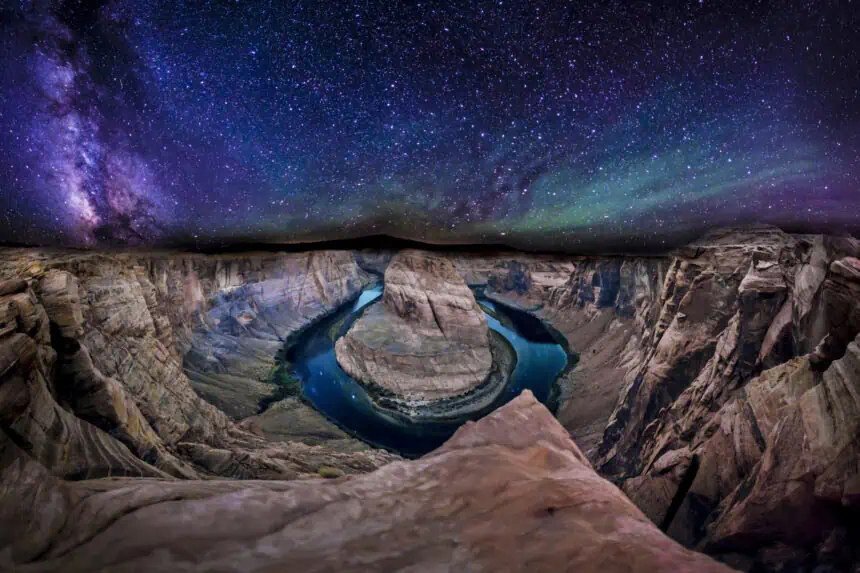

Friday night visibility boosted by geomagnetic activity
Tonight, Friday, June 7, 2025, parts of the northern United States may be treated to a dazzling display of the aurora borealis, thanks to recent solar activity. The National Oceanic and Atmospheric Administration (NOAA) has forecast moderate geomagnetic disturbances that could extend the visibility of the northern lights much farther south than usual.
Where to look for the aurora borealis
Based on the latest three-day forecast from NOAA, the aurora will likely be visible primarily across Canada and Alaska, but there’s a promising chance for visibility in the following eight U.S. states:
Northeastern Washington, northern Idaho, Montana, northern Minnesota, North Dakota, northern Wisconsin, Upper Michigan, and parts of Maine.
The Kp index, which measures geomagnetic activity on a scale of 0 to 9, is expected to reach:
- Kp 3 tonight (Friday), potentially increasing to Kp 4 by early Saturday morning.
- A stronger Kp 5 is projected for Saturday night, following the impact of a coronal mass ejection (CME) that erupted from the sun on June 4.
A Kp index of 5 signifies a minor geomagnetic storm, which is powerful enough to push the aurora borealis into latitudes across the northern Midwest and Northeast.
Best time and conditions to view the northern lights
The best time to observe the aurora is between 10:00 p.m. and 2:00 a.m. local time, in areas with low light pollution, a clear sky, and a northward-facing view. Optimal viewing points include elevated areas, such as rural hills or lakeshores, especially in regions with a history of strong auroral activity.
How to photograph the aurora borealis
For those aiming to capture the moment, NASA offers these tips:
With a DSLR or mirrorless camera, use a tripod, select a wide-angle lens, keep the aperture below f/4, and focus to infinity. If you’re using a smartphone, activate night mode, disable the flash, and keep the device still during long exposures.
Why the auroras are more frequent now
We are currently in the midst of a solar maximum, a peak phase in the sun’s 11-year cycle. During this period, solar flares and CMEs are more frequent. When these energetic particles reach Earth, they interact with oxygen and nitrogen molecules in the upper atmosphere, causing them to release vibrant light, which we observe as the aurora borealis.
NOAA and NASA both predict increased opportunities to witness these celestial displays in the lower 48 states through early 2026, thanks to heightened solar storm activity.
Stay alert, look to the northern sky, and be ready for a rare show of natural beauty over North America.