

Stratospheric polar vortex shifts explain region-specific cold snaps
Even as U.S. winters grow milder overall, bitter blasts of Arctic cold still manage to sweep across large parts of the country. A new study published in Science Advances offers a compelling explanation for why: the answer lies in the skies, more than 10 miles above our heads, in the changing behavior of the polar vortex.
The research, led by Chaim Garfinkel of the Hebrew University of Jerusalem, with collaborators from MIT, the University of Massachusetts, and other leading institutions, points to two distinct patterns in the stratospheric polar vortex—a high-altitude ring of icy air that encircles the Arctic each winter.
Depending on how this vortex shifts, it can send frigid air plunging into different parts of the United States, delivering some of the most extreme cold events in recent memory.
Two vortex patterns, two very different outcomes
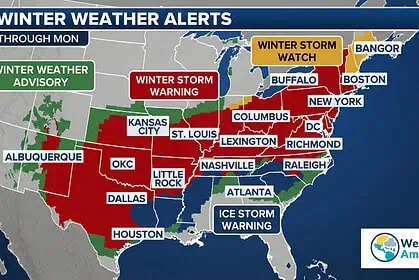
The study identifies two dominant forms of what’s known as a “stretched” polar vortex—a warped version of the normal circular flow. In one pattern, the vortex is pulled westward toward western Canada, setting up intense cold outbreaks across the Pacific Northwest. In the other, the vortex drifts toward the North Atlantic, steering Arctic air into the Central and Eastern U.S.
These shifts are driven by large-scale atmospheric waves, which act like ripples in the atmosphere, altering the path of the jet stream and dragging pockets of polar air much farther south than usual.
“People hear the term ‘polar vortex’ thrown around during cold spells, but what we found is that different shapes and positions of the vortex lead to very different impacts on the ground,” said Garfinkel.
Since 2015, the Northwest has been trending colder
Perhaps the most surprising finding is a regional cooling trend in the Northwestern U.S. since around 2015—a period during which the rest of the country has generally seen milder winters. This reversal, researchers say, aligns with a growing frequency of the westward-displaced vortex pattern.
That shift, in turn, appears to be tied to stronger negative phases of ENSO (El Niño–Southern Oscillation), one of the world’s major climate drivers. These broader climate cycles are now interacting with the stratosphere in new and more complex ways.
“Climate change doesn’t just warm everything evenly,” the researchers explained. “It also changes how and where extreme events happen—and sometimes that means more cold in places you wouldn’t expect.”
Texas freeze and other surprises from the sky
The study also helps explain the devastating cold snap that hit Texas in February 2021, knocking out power for millions and causing hundreds of deaths. That event was one of the clearest examples of how a shifted polar vortex can unleash brutal Arctic air far beyond its usual boundaries.
Other regions, including Montana and parts of the Central Plains, have seen similar patterns play out in recent winters. Meanwhile, areas farther east may see fewer outbreaks, thanks to the changing dynamics high above the Arctic.
Forecasting winter’s high-altitude drivers
Understanding how the stratosphere shapes weather on the surface could open the door to more accurate long-range winter forecasts. By tracking vortex patterns weeks in advance, meteorologists could give better warning of potential cold waves, allowing cities, utilities, and farmers to prepare—particularly as the warming climate continues to rewrite the rules of seasonal weather.
In short, what happens high above the Arctic no longer stays there. From Oregon to Oklahoma, its influence is increasingly being felt here on the ground.