

Geomagnetic activity forecast for Monday night
According to the National Oceanic and Atmospheric Administration (NOAA), minor geomagnetic storms are expected to develop tonight—Monday, June 18—as the result of high-speed solar winds stemming from a coronal hole, a cooler and less dense region on the sun’s surface. These storms could produce the aurora borealis—commonly known as the northern lights—across several northern U.S. states.
The NOAA’s forecast indicates a Kp index of three, with the potential to reach nearly five overnight. The Kp index, ranging from 0 to 9, measures geomagnetic activity: a Kp of five or higher generally signifies strong enough activity for aurora visibility at mid-latitudes. At tonight’s level, the northern lights may be visible further south than usual, offering a rare opportunity for skywatchers.
States most likely to see the aurora borealis
If conditions remain favorable, residents across parts of the northern U.S. may catch a glimpse of the dazzling lights. NOAA’s three-day aurora forecast highlights the following states as having the highest likelihood of visibility:
South Dakota, Wyoming, Iowa, New York, New Hampshire, Vermont, Maine, and Montana.
Additionally, a lower but still possible chance of visibility extends to northeastern Washington, northern Idaho, North Dakota, northern Wisconsin, and Upper Michigan.
Best viewing conditions and timing
To maximize your chance of seeing the northern lights, NOAA recommends heading to a dark, elevated area, well away from urban light pollution. The most favorable viewing window is between 10:00 p.m. and 2:00 a.m. local time, when geomagnetic activity is typically strongest.
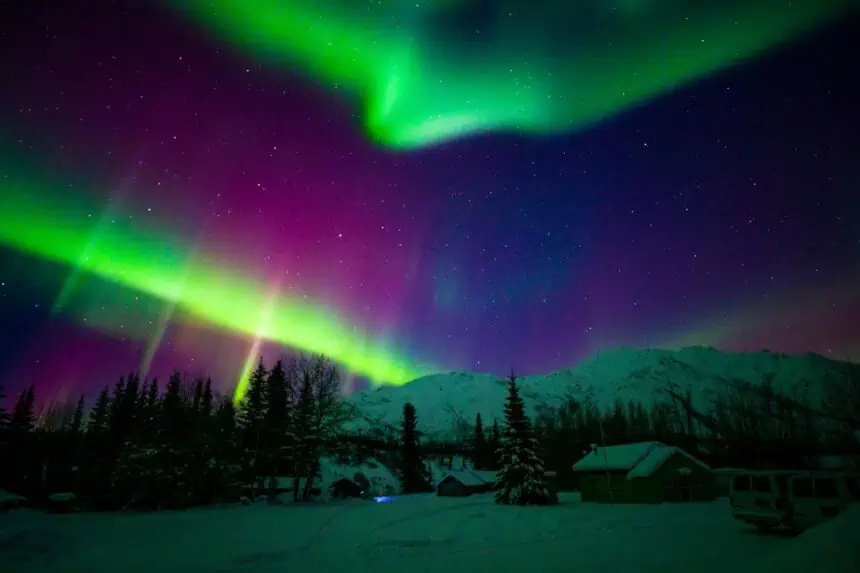
Cloud cover and light interference will greatly affect visibility, so clear skies and rural locations offer the best opportunity. Keep in mind that the lights may appear as faint glows on the horizon or, in stronger bursts, as vivid ripples of green, red, or purple light dancing across the sky.
Photographing tonight’s aurora
To capture the northern lights, experts suggest using a wide-angle lens, setting your aperture at f/4 or lower, and adjusting focus to infinity. For smartphone users, enable night mode and use a tripod to reduce blur during long exposures. Patience is essential; even under the right conditions, auroras can be elusive and short-lived.
Solar activity cycle and outlook through 2026
NOAA and NASA projections show that auroral activity will remain elevated into early 2026, as we near the peak of Solar Cycle 25, which reached a significant high point in October 2024. This period features an increase in solar flares and coronal mass ejections, fueling the energetic particles that spark the aurora by exciting molecules of nitrogen and oxygen in Earth’s upper atmosphere.
Stay tuned to NOAA’s space weather alerts for continued updates on visibility and storm conditions.