
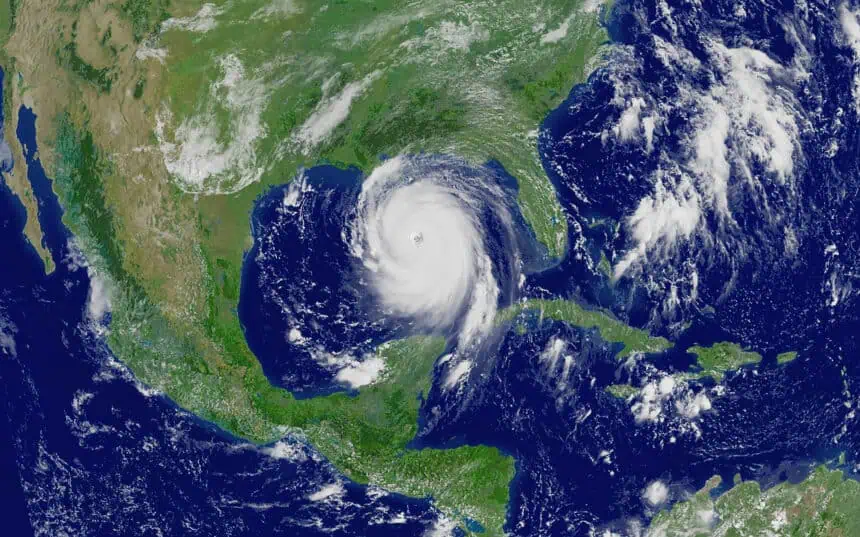

Mexico is closely watching the development of a new tropical system in the Pacific Ocean that could soon become Cyclone Gil, the seventh named storm of the season. The National Water Commission (Conagua) and the National Meteorological Service (SMN) are monitoring a low-pressure area that’s currently showing signs of intensifying.
As of this Friday morning, July 5, the system is located about 345 miles (555 kilometers) south-southwest of Acapulco, Guerrero, and is moving west-northwest. It’s currently tied to Tropical Wave No. 8 and carries a 40% chance of developing into a tropical cyclone in the next 48 hours, increasing to 80% over the next seven days.
Where Gil is expected to develop
The low-pressure zone is forecast to evolve into a tropical cyclone by the weekend, remaining south of the coasts of Guerrero and Michoacán. If it continues on this trajectory and strengthens, the system will officially become Cyclone Gil. This would mark the seventh tropical system of the 2025 Eastern Pacific hurricane season.
So far this year, the Eastern Pacific basin has seen three tropical storms—Alvin, Cosme, and Dalila—along with three hurricanes: Bárbara, Erick, and Flossie.
Expected impacts and rainfall by Saturday
Starting Saturday, July 5, the system will likely move parallel to the coasts of Guerrero, Michoacán, and Colima, dragging with it moisture-laden clouds. These could lead to widespread showers and strong thunderstorms in several regions of southern and western Mexico.
The storm’s circulation and outer rainbands are expected to bring moderate to heavy rain across a wide stretch of the country.
On Saturday, rainfall forecasts include:
Heavy to very heavy rainfall (2 to 3 inches / 50 to 75 mm) in parts of southern Sonora, southern Chihuahua, Durango, Sinaloa, and Nayarit.
Scattered strong showers (1 to 2 inches / 25 to 50 mm) in Coahuila, Nuevo León, Zacatecas, Aguascalientes, Jalisco, Colima, Michoacán, Guerrero, Oaxaca, and Chiapas.
Light to moderate showers (0.2 to 1 inch / 5 to 25 mm) in Tamaulipas, San Luis Potosí, Guanajuato, Querétaro, Hidalgo, Mexico State, Mexico City, Morelos, Tlaxcala, Puebla, Veracruz, Tabasco, Campeche, Yucatán, and Quintana Roo.
While the system’s future is still being determined, all eyes are now on the Pacific, as Cyclone Gil could be taking shape just offshore.