
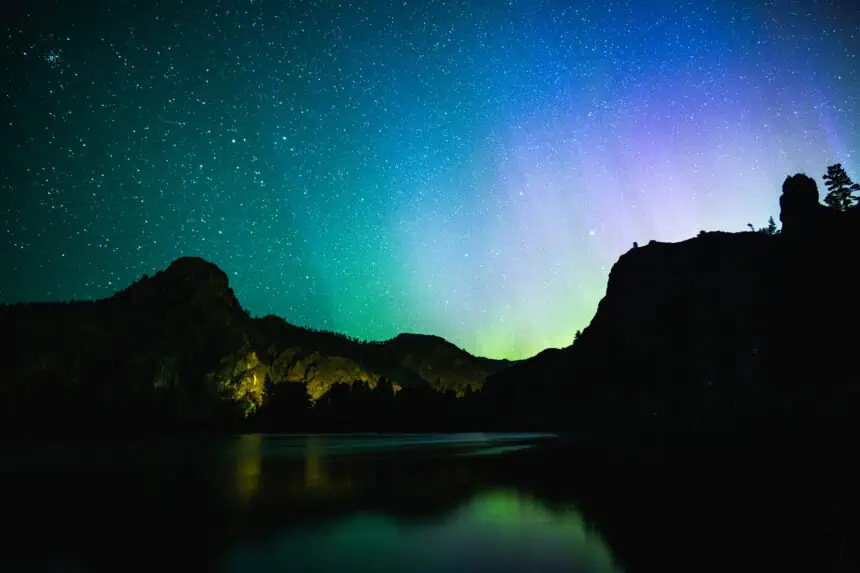

Aurora borealis visible over Montana, North Dakota and northern Michigan
Tuesday night, according to the latest forecast from the National Oceanic and Atmospheric Administration (NOAA), there’s a good chance of spotting the northern lights across parts of the northern United States, thanks to a period of calm geomagnetic conditions following earlier solar storms.
The auroral activity level, measured by the Kp index, is expected to hit three on a scale of zero to nine. This reading means the aurora borealis may be visible farther south than usual and could provide a striking visual display for those in the right locations.
Best areas to view tonight’s aurora
The minimal viewing line is forecast to stretch just south of the Canadian border, with some visibility likely across northeastern Washington, northern Idaho, Montana, North Dakota, northern Minnesota, northern Wisconsin, and the Upper Peninsula of Michigan. The chances are much higher across most of Canada and Alaska.
According to NOAA, Tuesday night offers the strongest visibility window of the week. The Kp index will likely drop to two on both Wednesday and Thursday, which means reduced aurora chances.
No incoming geomagnetic storms expected
There are no geomagnetic storms or elevated solar radiation levels expected through Thursday night, NOAA says. Earlier coronal mass ejections triggered only minor disturbances, but they were still powerful enough to push auroral visibility deeper into the U.S.
When and where to watch the northern lights
NOAA recommends heading out between 10:00 p.m. and 2:00 a.m. local time, looking from a high, unobstructed point facing north, and making sure to stay far from city lights or other sources of light pollution.
How to photograph the northern lights
NASA suggests enabling night mode, turning off the flash, and choosing a slow shutter speed when using a smartphone. For a traditional camera, a tripod, wide-angle lens, an aperture of f/4 or lower, and infinite focus are ideal for capturing the aurora’s glow.
A banner year for aurora watchers in the U.S.
Over the past year, more people across the United States have had the chance to witness this dazzling phenomenon. That’s because the sun is currently in a solar maximum phase—part of its regular 11-year activity cycle. During this time, solar flares and coronal mass ejections send charged electrons toward Earth, where they collide with oxygen and nitrogen in the upper atmosphere, releasing energy as the vivid colors of the northern lights.
For Tuesday, June 10, 2025, residents of Montana, North Dakota, Upper Michigan, and the northern regions of Minnesota and Wisconsin could have one of the last great chances this season to witness the aurora borealis before solar activity begins to quiet down.